
The whole-school approach your staff can run
Start with a $20 practice review that tells your leadership team where your school stands. Then, if you want it, the full program: the teaching and learning resources, the term planner, and the audit tool that helps you draft your anti-bullying policy. Built on more than 25 years of Australian research.
If any of this is true at your school, you are the reason we built it
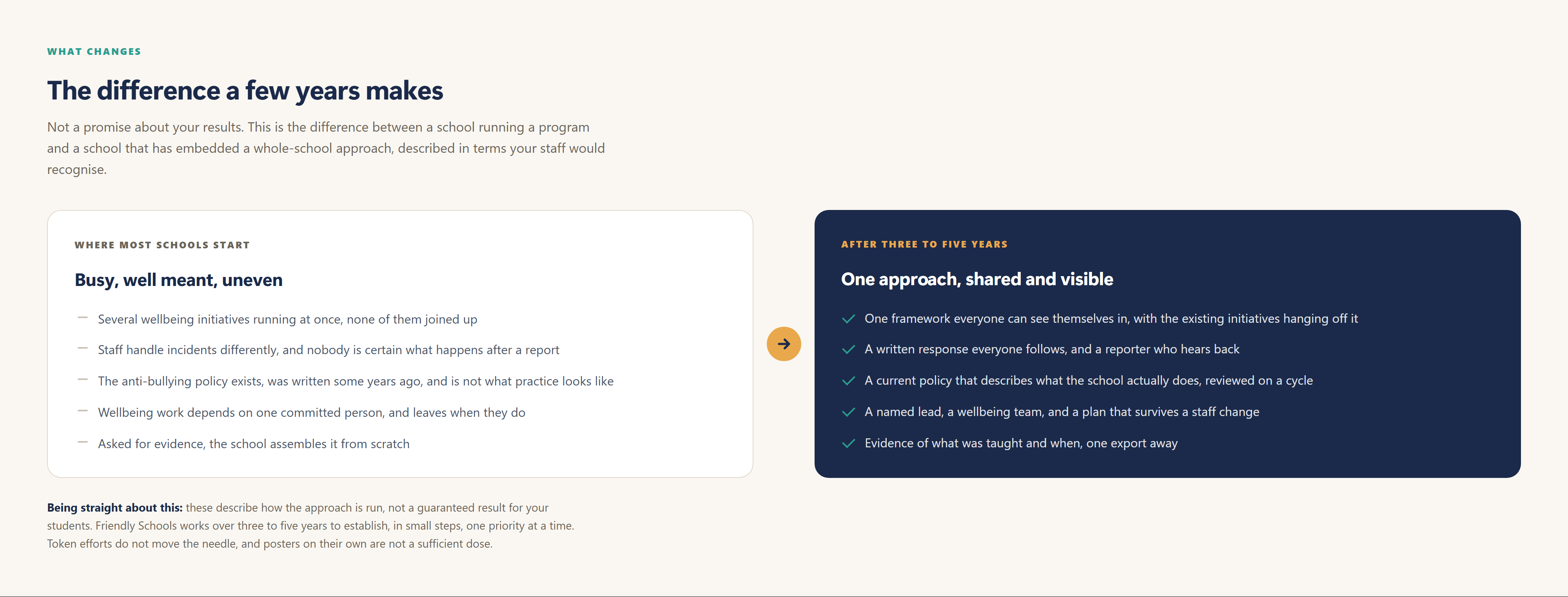
Several things running at onceYou have a wellbeing program, a behaviour framework and a few good initiatives. None of them quite join up, and nobody can say which one is doing the work.
It depends on one personOne committed staff member holds it together. When they take long service leave, it stops.
The policy is not what happensThere is an anti-bullying policy. It was written some years ago, and it does not describe what your staff do on a Tuesday.
None of that means your school is doing badly. It means the work is not joined up yet.
Two products. Start with either.
Map the Gap
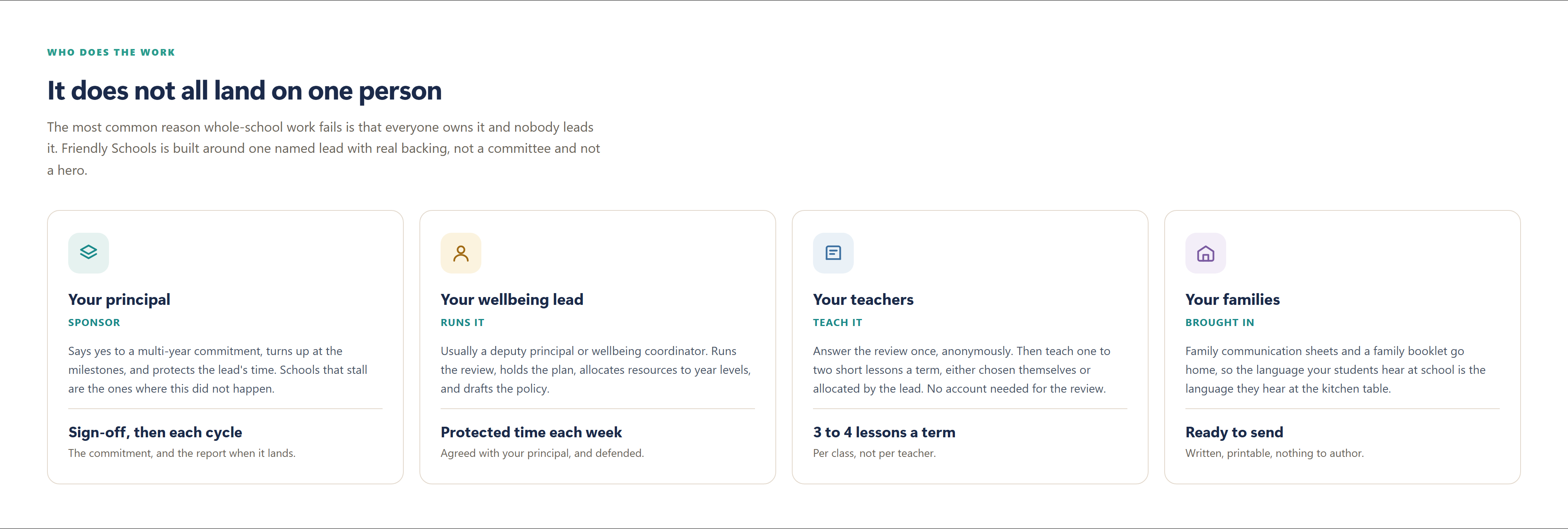
A whole-school staff practice review. Your wellbeing leader creates the account, sends staff an anonymous link, and gets back a leadership-ready report showing where your school is strong and where the opportunities are.
One person logs in. Your staff never need an account, a password, or any training to take part.
Your results and your priorities carry straight into the full program if you go on. Nothing is re-done.
The full program
Everything in Map the Gap, plus the teaching and learning resources for every year level, the term planner, and the audit tool for your anti-bullying policy and your evidence.
Your teachers get their own accounts and their own view of the platform.
Priced per school, not per student.
Eight components, grouped into six areas
Your school is reviewed across all eight. The resources, the planner and the audit tool are indexed to the same six areas, so you can go from a flagged area straight to the material for it. Coverage is deepest in Key Understandings and Competencies, and we are building out the other areas.
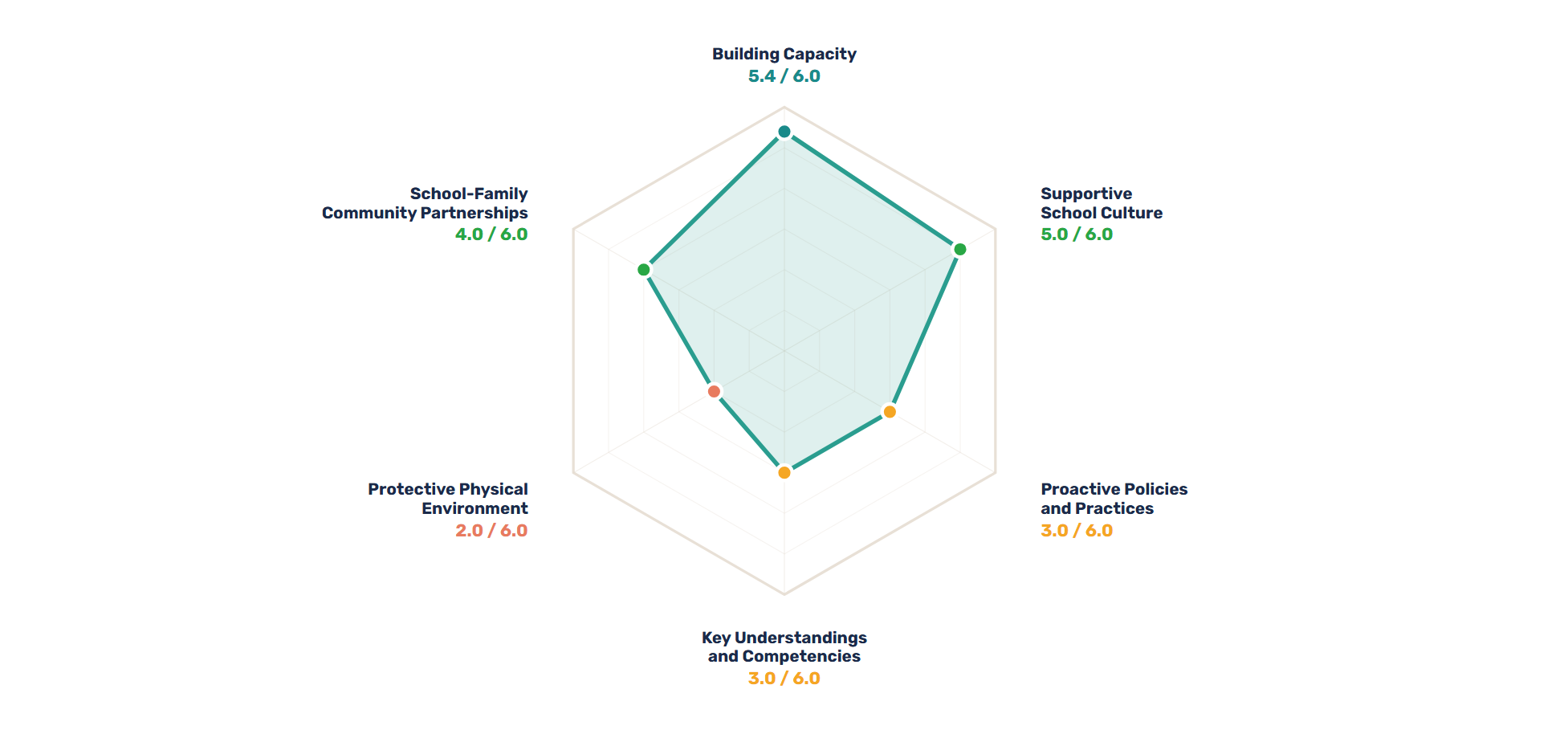
Your staff score your school's current practice, anonymously. You get back your strengths first, then your areas of opportunity, ranked.
The teaching and learning resources, the term planner and the whole-school toolkits, matched to the areas the review surfaced.
The Leadership Report for your executive, and the audit tool's evidence export for anyone reviewing your school.
Additional support is offered in person or virtually, and a complimentary exploration session is available. Tell us what you need.
The product your school opens every week
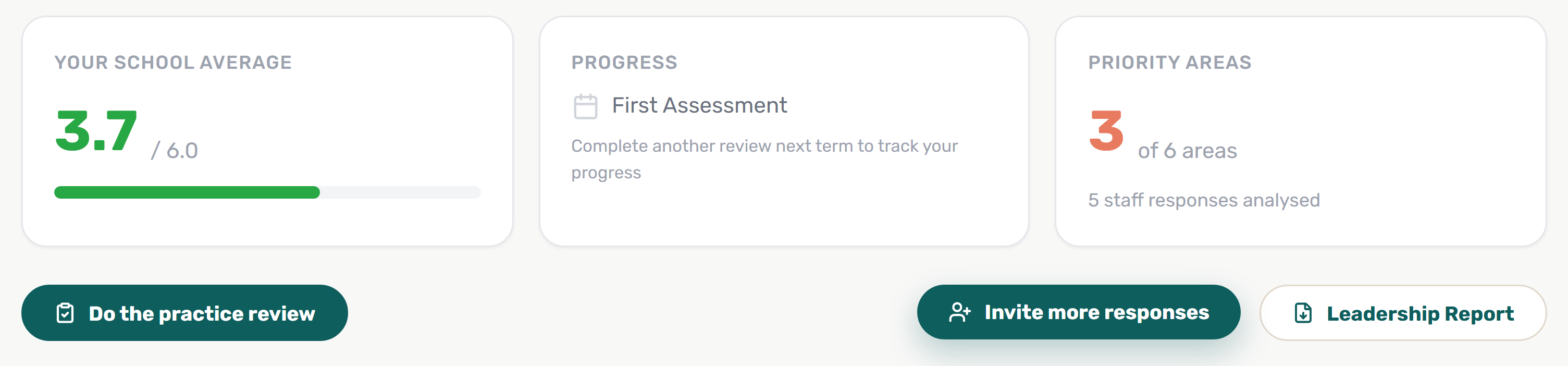
Strengths first, then the work
Your results open on what your school already does well, because that is the foundation the next piece of work stands on. Then the areas of opportunity, ranked, so your team takes on two or three rather than all six.
Anonymous, and it stays that way
Staff answer through a link with no account and no password. Every response is stored against the same anonymous marker, and exports render every respondent as "Anonymous". Even the wellbeing leader cannot see who said what.
Watch: what Map the Gap is · 1:26
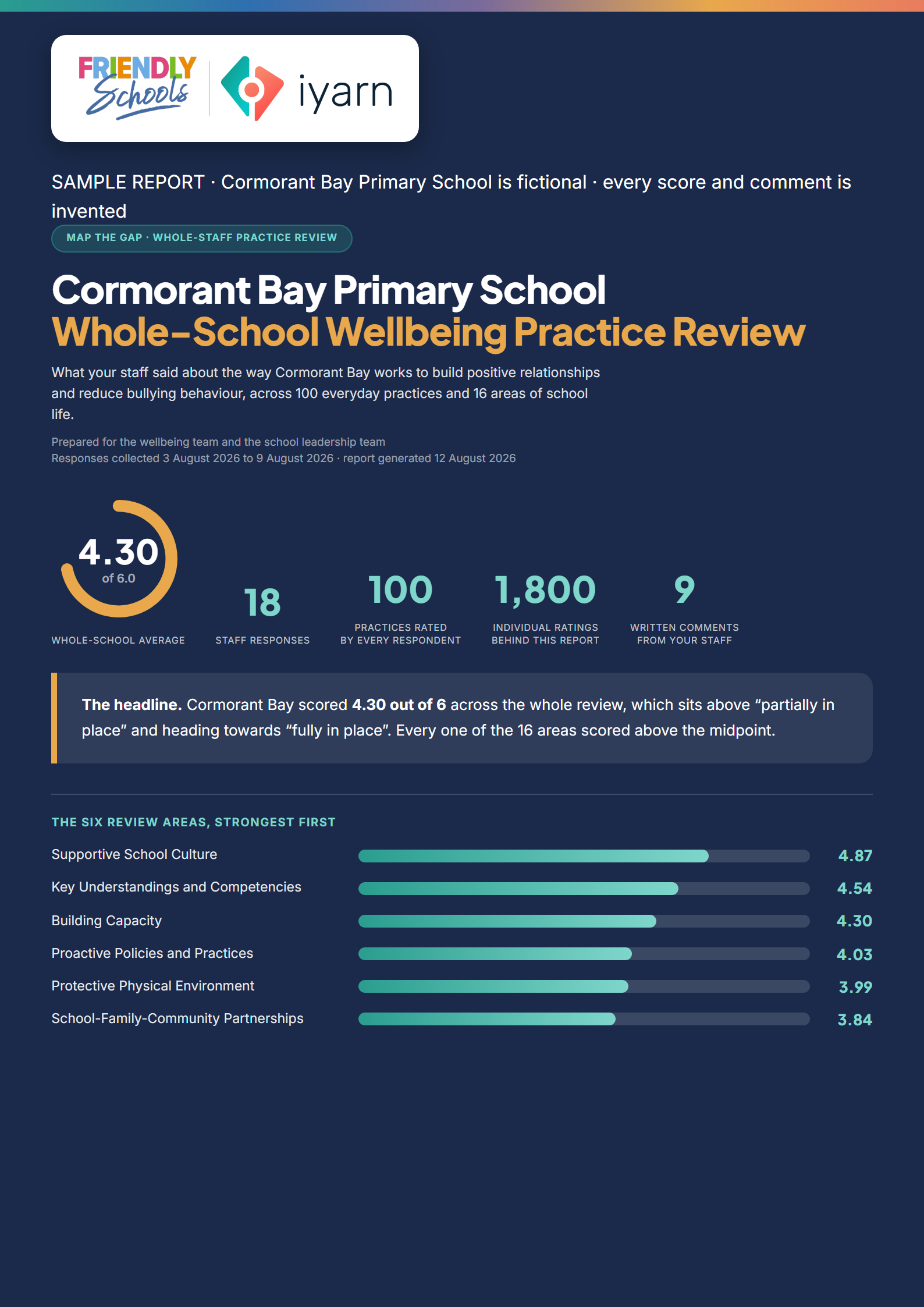
Read a full Leadership Report
The whole-school average, all six areas ranked, the areas of school life underneath them, what your staff say you already do well, and the priorities worth taking on first with a concrete step for each.
Cormorant Bay Primary School is fictional and every number in it is invented, so you can read the whole thing without anyone's real school data being involved. It is an illustration of the shape and depth of a report, not a copy of any school's.
Download the sample report PDF · 10 pagesWatch: the Leadership Report · 0:54
What a year of this looks like
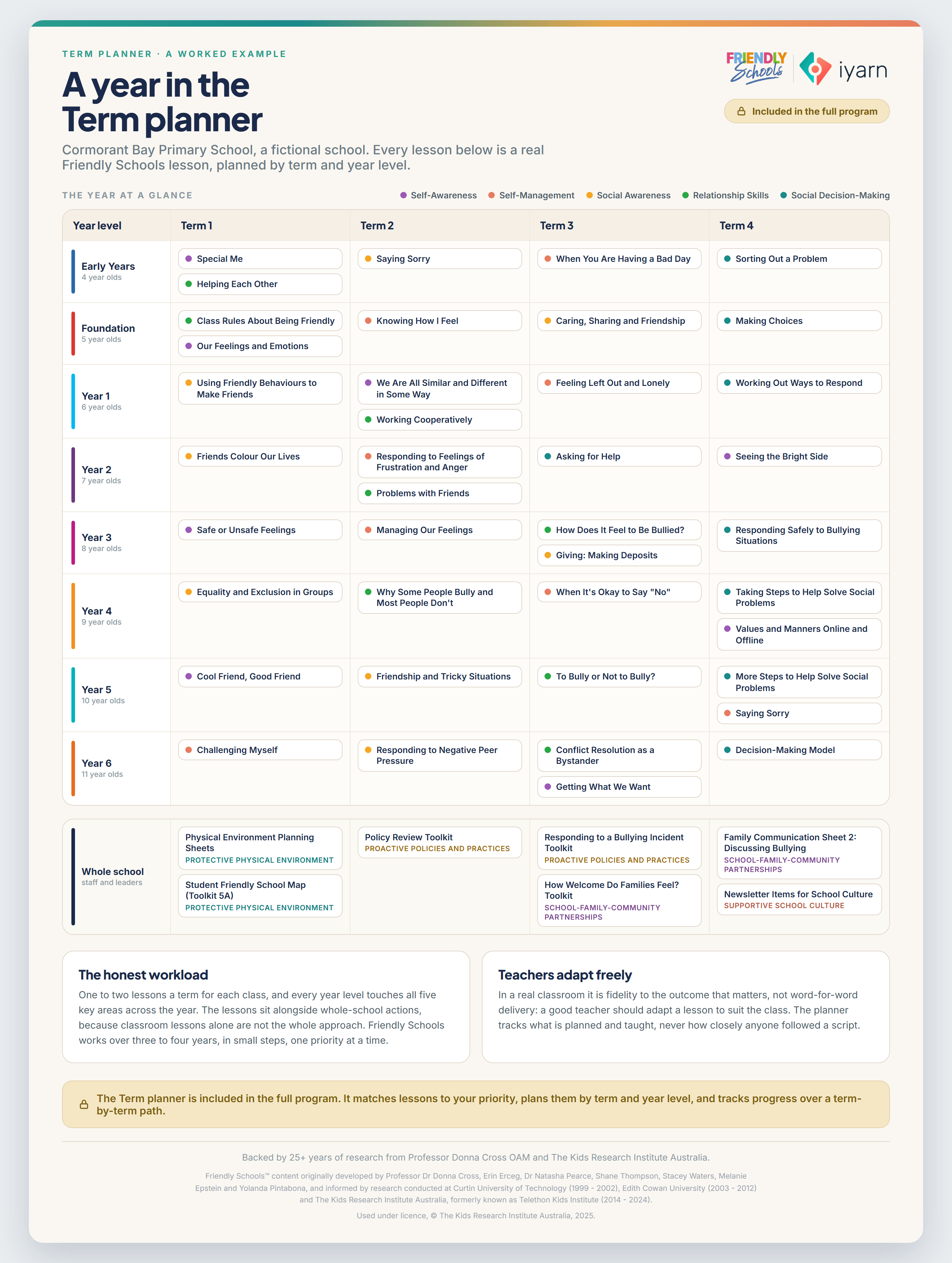
The workload is small
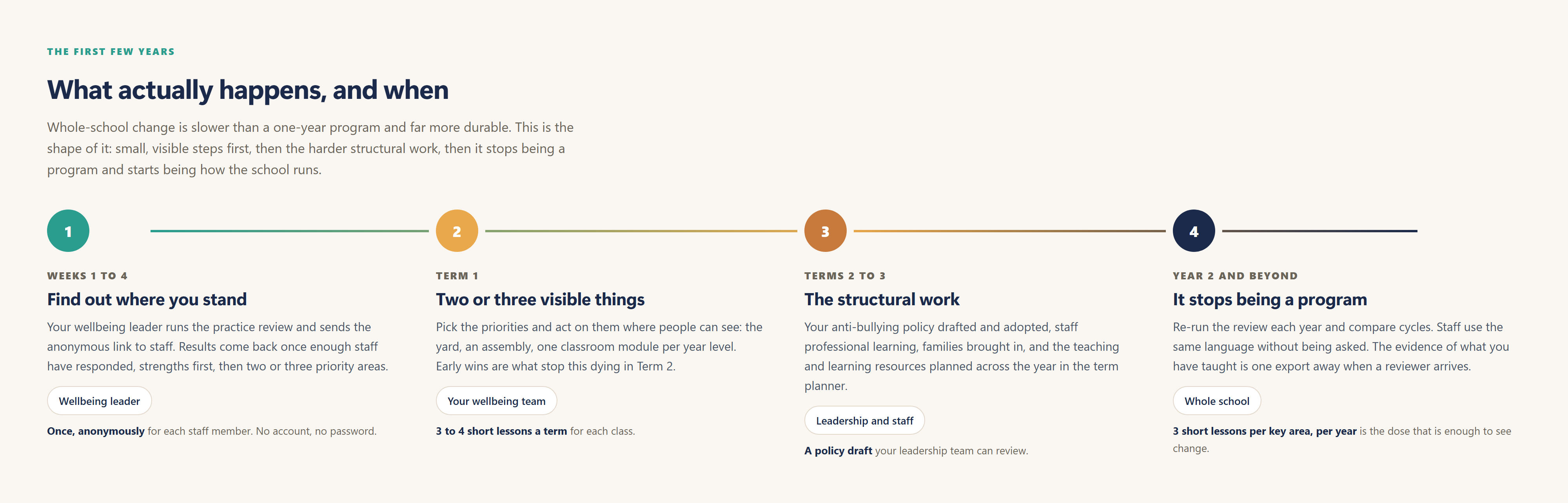
Three to four short lessons a term for each class. That is the dose the research asks for: about three per key area across the year.
Teachers adapt freely
It is fidelity to the outcome that matters, not word-for-word delivery. The planner tracks what was planned and what was taught, never how closely anyone followed a script.
Watch: from priorities to a term plan · 1:37
Your anti-bullying policy, and the evidence behind it
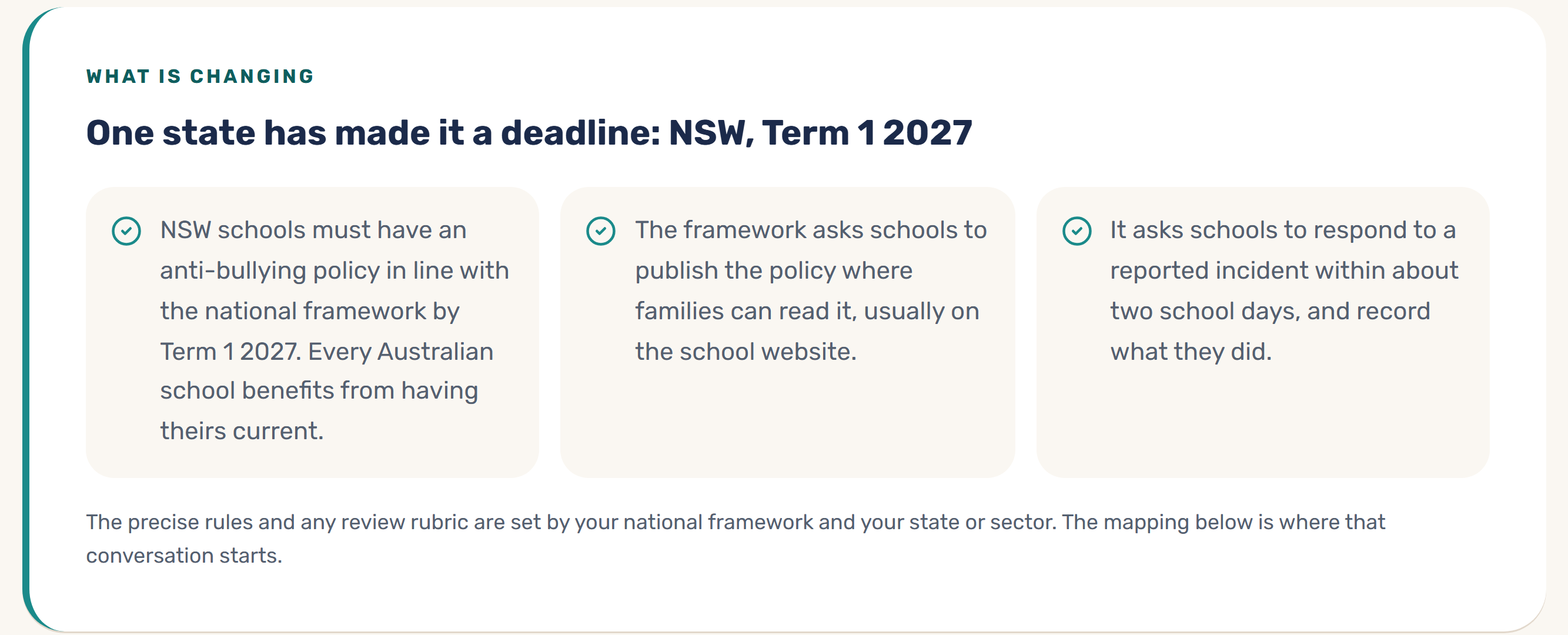
The National Framework for Addressing Bullying in Australian Schools was agreed by all Education Ministers in February 2026. It asks every school to embed it in policy and procedure, publish the policy where families can read it, and respond to a reported incident within about two school days.
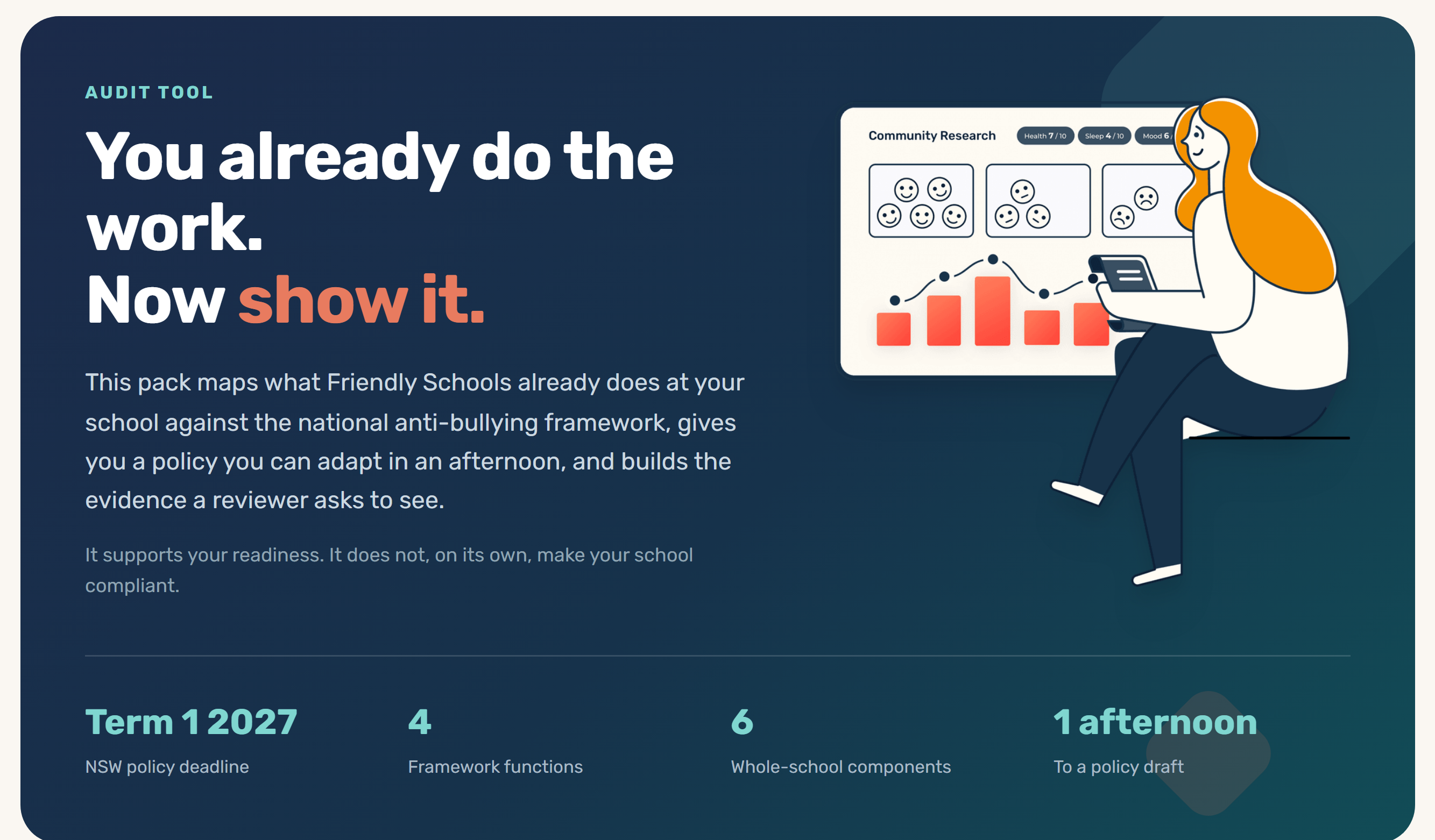
One state has made it a deadline: NSW schools must have an anti-bullying policy in line with the framework by Term 1 2027. Every other school benefits from having theirs current.
We tell you where we do not help
Friendly Schools strengthens prevention and culture. Incident response stays with your school's existing process, and the tool says so on the screen rather than implying coverage you do not have.
Start with what you already do
Upload your current documents: your existing anti-bullying policy, your wellbeing policy, procedures, anything relevant. They are listed in your evidence export, so a reviewer can see what your school already has on file.
The required fields are required for a reason
They are the sentences only your school can write. An earlier version of this tool wrote them for you, and a policy that says things about your school nobody at the school ever said is worse than no policy at all. It becomes a red flag the moment a reviewer audits it against practice you do not have.
So the draft will not put words in your mouth. Anything you leave blank appears in the document as a visible field to complete, never as plausible filler.
Show the work when someone asks
Download the evidence export: a printable summary drawn from your school's own activity. Reviews run, areas addressed, and lessons taught by term. It reports only what has been recorded.
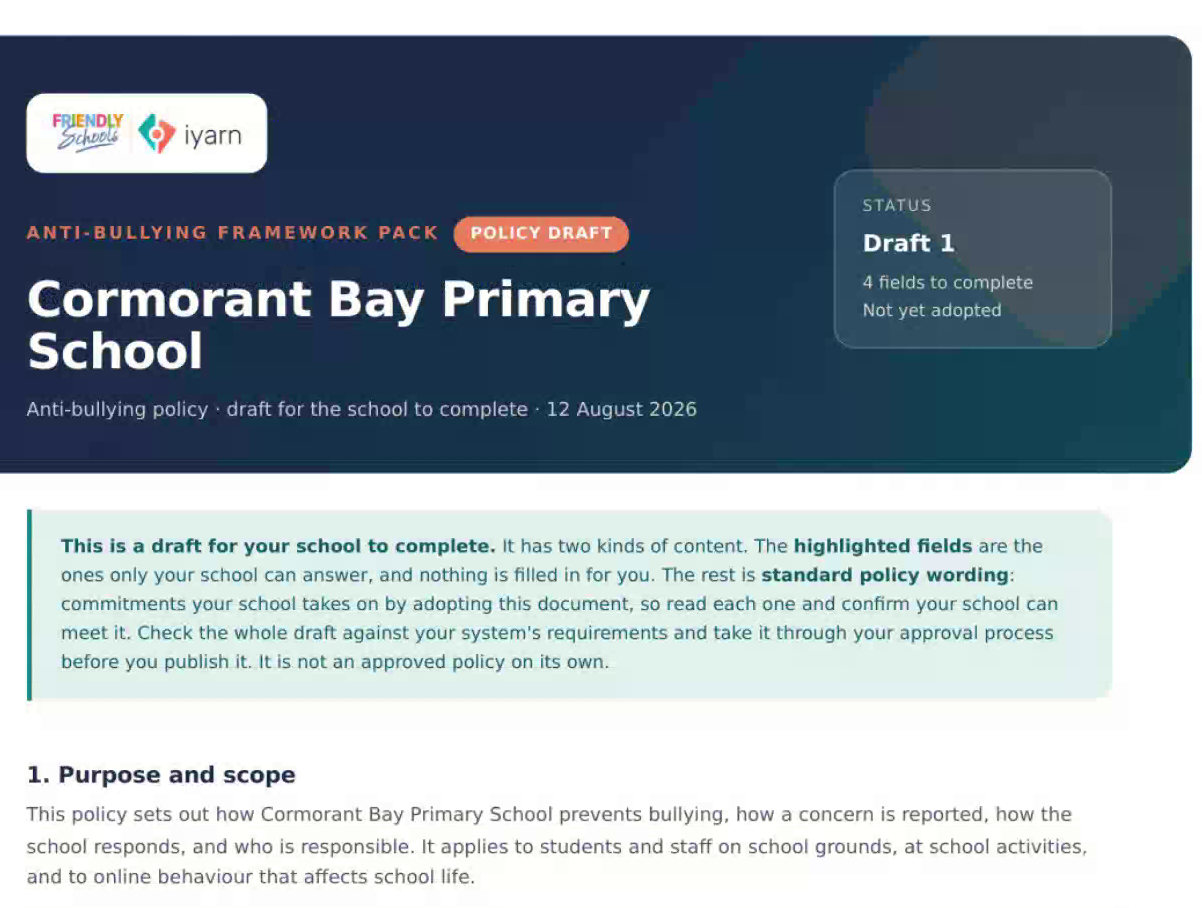
What it does not do. It does not make your school compliant, and no software can. It supports your readiness, it gives your leadership team a real draft to work from instead of a blank document, and it gives you the evidence in one place when someone asks for it. The precise rules and any review rubric are set by your framework and your state or sector.
Part of the full program. The $20 pilot shows you the framework mapping. The audit, the policy draft and the evidence export open with the full program.
Watch: drafting your policy · 1:56
Watch: evidence for reviewers · 0:46
Two kinds of resource, and they are genuinely different
For adults
Evidence for Practice, the whole-school guidebook, and 26 whole-school resources your leaders, your wider school community or your staff professional learning sessions can run. This is the part that changes how the school works, not just what happens in a classroom.
For classrooms
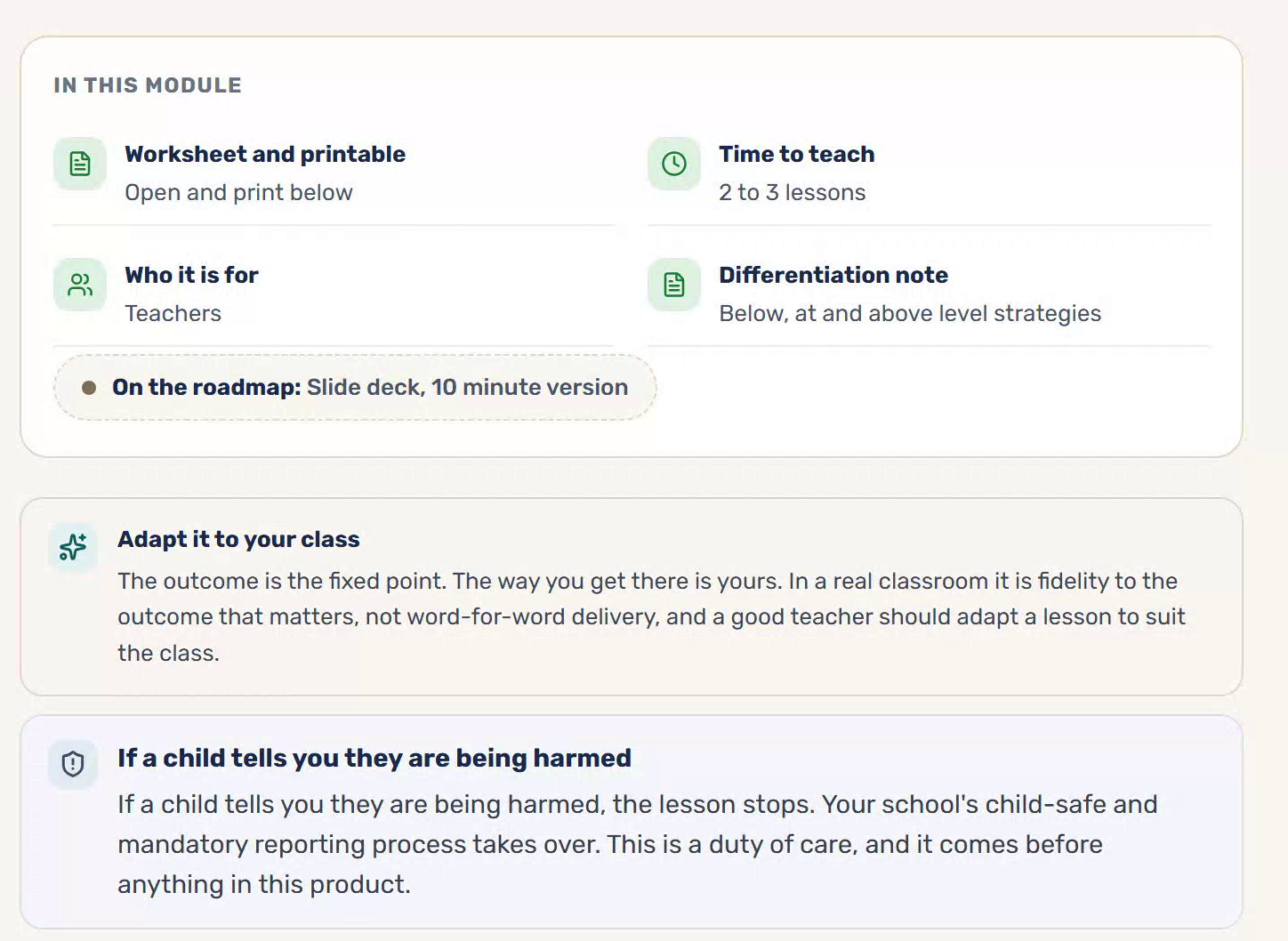
Student-led teaching and learning resources from Early Years through to Year 9. Open a lesson and you get what will be taught and how long it takes, the outcomes, the activities, the script for teachers who want one, discussion questions and reflections, and the teacher resources needed.
If a child discloses harm, the lesson surfaces the duty of care guidance for the teacher right there, on the page.
Watch: the resource library · 2:20
Two products, and the shop
Map the Gap
- One account, for your wellbeing leader. Nobody else needs a login
- An anonymous review link. Send it to your whole staff. There is no cap on how many complete it.
- The optional readiness check
- Your results: strengths first, then your areas of opportunity, ranked
- The Leadership Report, exportable, built for your executive meeting
- Strategies for Action against each area of opportunity
- The whole-school resources, family sheets, family booklet and posters
- A look at the term planner and the audit tool
- 30 days in the platform, then your results stay available
Self-serve. No sales call. One-off payment, no auto-renewal, nothing to cancel.
The full program
- Small · up to 200 students · $3,000 a year
- Medium · up to 600 students · $5,000 a year
- Large · 600+ students · $7,000 a year
Priced per school, not per student.
- Everything in Map the Gap, and your pilot's results and priorities carry over
- Accounts for your teachers, with their own view
- The full resource library, Early Years to Year 9
- The term planner, by term and year level
- The audit tool in full: current-documents audit, policy draft, evidence export
- The welcome pack and implementation plan
Invoiced annually, not a self-serve checkout. We will talk to you first.
Additional support
Additional support is offered in person or virtually, and a complimentary exploration session is available. Tell us what you need and we will price it.
The shop: printed and PDF resources
The original Friendly Schools teaching and learning resources, for schools that want them outside a subscription. All PDFs, with unlimited printing inside your school.
Bought Friendly Schools resources before? Your files are still yours. Sign in to My Account and your purchases are there to download, as they always have been.
What you get at each level
| Map the Gap $20 one-off | Full program $3,000 to $7,000/yr | |
|---|---|---|
| Whole-school practice review, eight components in six areas | Yes | Yes |
| Anonymous staff link, no accounts needed, no cap | Yes | Yes |
| Readiness check | Yes | Yes |
| Leadership Report | Yes | Yes |
| Strategies for Action | Yes | Yes |
| Whole-school resources, family sheets and posters | Yes | Yes |
| Term planner and audit tool, visible | Yes | Yes |
| Teacher accounts and teacher view | No | Yes |
| Full lesson materials, Early Years to Year 9 | Browse only | Yes |
| Term planner, working | No | Yes |
| Audit tool: current-documents audit | No | Yes |
| Audit tool: anti-bullying policy draft | No | Yes |
| Audit tool: evidence export | No | Yes |
Six findings behind the program
Numbers schools quote when making the case to their board.
Australian students in Years 4 to 9 report being bullied at school.
A published, peer-reviewed body of Australian research since 1999, open and inspectable.
Australian children studied, from foundational primary trials through national cyberbullying research.
ISO/IEC 27001:2022 certified
The platform behind Friendly Schools · certificate 8726-2966-01
Assessed under the ST4S framework
Safer Technologies 4 Schools
Start with Map the Gap.
Your school reviewed across all eight components in six areas, and a leadership-ready report with a ranked list of priority areas.
Self-serve · 30 days in the platform · no sales call required

Evidence-based wellbeing for Australian schools. Built on 25+ years of research at The Kids Research Institute Australia.
Friendly Schools acknowledges the Whadjuk Noongar people as the traditional custodians of the land on which our work began, and pays respect to Elders past and present.