
A clear path from $20 review to whole-school change
Five stages. Eight components. Built on 25+ years of Australian research and aligned to both the federal Anti-Bullying Rapid Review and the NSW Anti-Bullying Framework that takes effect in Term 1, 2027.
Built for the person who owns wellbeing at your school
Friendly Schools is whole-school work, but the journey is steered by one coordinator plus committed leadership. If that’s you — or if you’re recruiting the person it will be — this page shows exactly what the next 12–24 months looks like, stage by stage.
Five stages from getting ready to sustaining change
Every Friendly Schools implementation runs through the same five-stage cycle. The first pass takes 12–24 months; after that, schools repeat stages 2–5 annually to keep the work current.
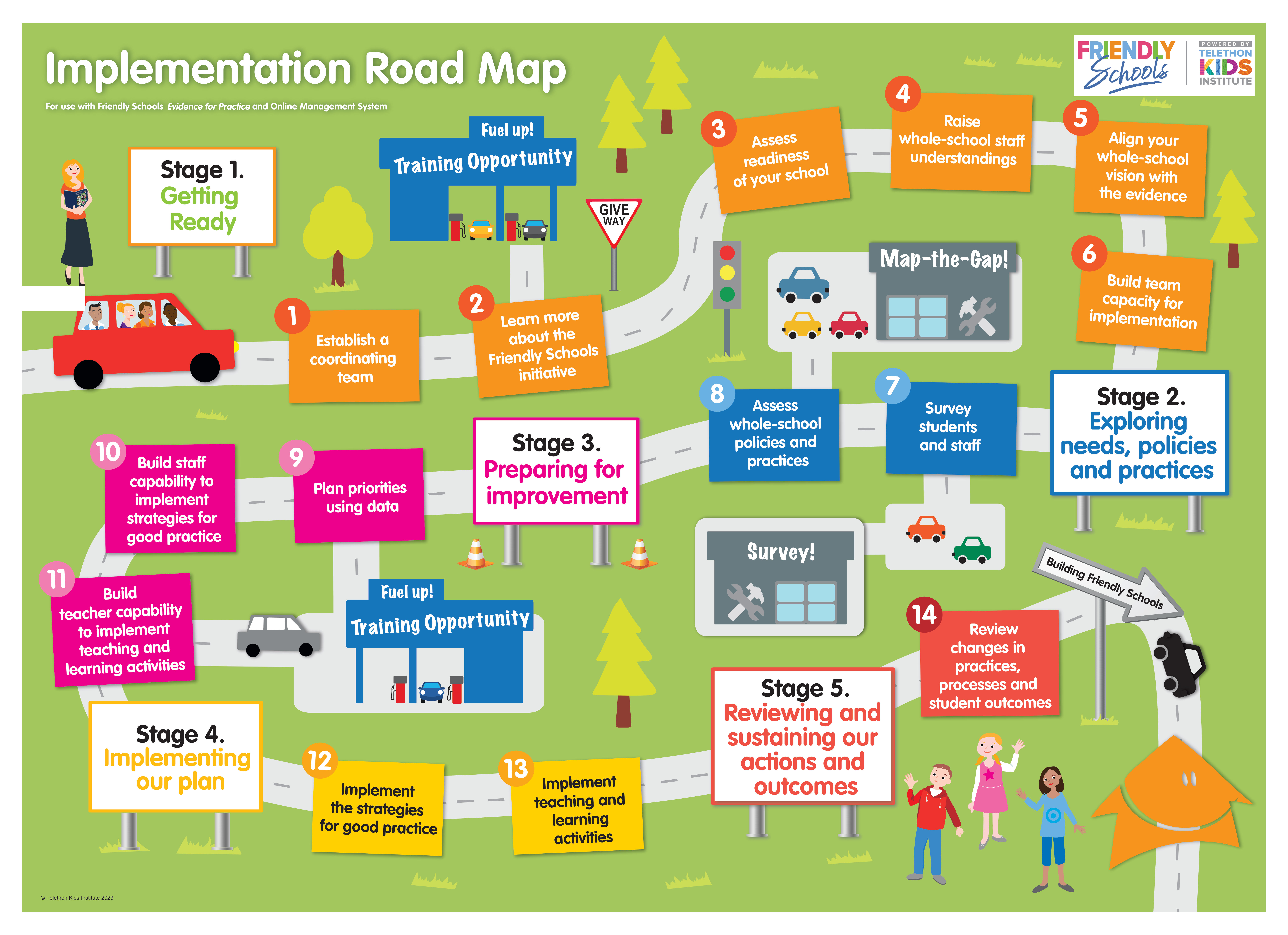
Implementation Road Map (HBP383) · Friendly Schools Plus. The page below is the 2026 digital version of the same 5-stage journey.
Getting Ready
Before you do anything with students, you build the infrastructure for change. Leadership commits, a coordinating team is formed, and the whole-school vision is defined. This is the stage where most implementations succeed or quietly fail — the commitment you build here determines whether it lasts.
Explore Strengths and Needs
You can’t plan what you haven’t measured. Your staff complete Map the Gap to review your school across the 8 whole-school components, identifying what you do well and where the biggest gaps are. Student and staff surveys add a second data layer.
Plan for Improvement
Taking all eight components at once is how implementations collapse. This stage is about picking the two or three priority areas Map the Gap flagged and writing a realistic plan: who does what, by when, with what resource. Small wins first build momentum.
Implement Plan
Classroom curriculum goes live. Staff professional learning is under way. Policies are updated. Break-time supervision changes. Student voice mechanisms start working. This stage is the longest and the most variable — it’s where teachers need support, and where the Friendly Schools teaching and learning resources do the heavy lifting.
Reflect and Review
After a year of implementation, you pause, look at what changed, and decide what to adjust. Re-run Map the Gap to see how scores moved. Update the plan for the next 12 months. Keep what’s working, drop what isn’t. The strongest schools treat this as an annual habit, not a one-off review.
The eight components you work across
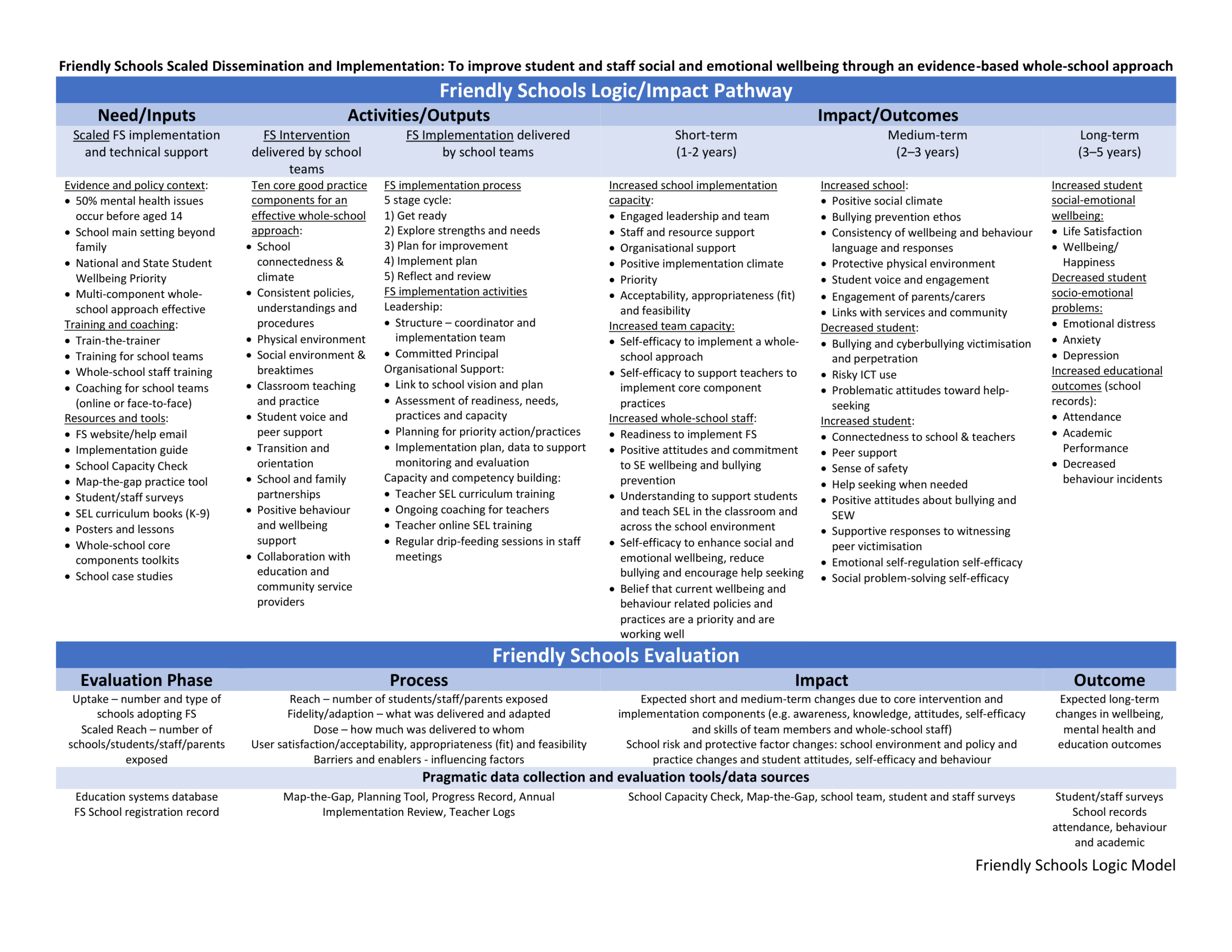
These are the eight components Friendly Schools research identified as essential for a whole-school approach that changes wellbeing. Your school is reviewed and improves across each one. Language below is the canonical phrasing used in the Map-the-Gap review tool.
School Connectedness & Climate
Create a sense of belonging and connection amongst the whole school community.
Consistent Understandings and Procedures
Establish consistent wellbeing and behaviour understandings, policies, and responses.
Physical Environment
Build a safe and supportive school physical environment that also promotes wellbeing.
Social Environment and Breaktimes
Target opportunities for social, emotional learning, and high-risk times for poor student behaviour.
Classroom Teaching and Practice
Teach developmentally appropriate social and emotional pedagogy that builds student–teacher and student–student relationships.
Positive Behaviour and Wellbeing Support
Strengthen response and support for students in need.
Student Voice and Peer Support
Empower student voice and peer support.
School and Family Community Partnerships
Engage parents/carers and families in partnership for student wellbeing.
Is your school ready?
Before Map the Gap, there are 11 questions that tell you whether your school has the foundation to make a whole-school approach stick. These questions form the core of the School Readiness Check, run by your coordinating team at the start.
- How committed is leadership to a whole-school approach to social and emotional wellbeing and bullying prevention?
- How well established is your coordinating / wellbeing team?
- How well informed are the members of your coordinating / wellbeing team about the Friendly Schools initiative?
- How well does this Friendly Schools approach fit with current priorities and actions within the school?
- How well does this Friendly Schools approach fit with current district, system and state priorities?
- How well does this fit with current knowledge of student needs?
- How well does this fit with current family and community contexts?
- How well does this fit with current staff priorities?
- How amenable do you think staff are going to be to implementation?
- How well prepared are the members of your staff for implementation?
- Overall, how ready do you think your school is to start working with the Friendly Schools initiative?
This is multi-year work. Token efforts don’t move the needle.
Whole-school change is slower than a single-year programme but far more durable. Here’s the realistic timeline Friendly Schools has observed across 25 years of implementations.
Year 1
Stages 1-3 complete. Coordinating team, Map the Gap done, priority components chosen, plan written. First classroom curriculum goes live.
Years 2-3
Full classroom curriculum in place. Staff professional learning under way. Policies updated. Student voice mechanisms running. First cycle of Reflect & Review.
Years 3-5+
Annual Map the Gap cycles. Continuous iteration. Embedded in the school’s culture rather than a ‘programme’ alongside it.
“Token efforts will not work. Posters are not a sufficient programme dose to make a difference in students’ lives.”
Your first concrete step
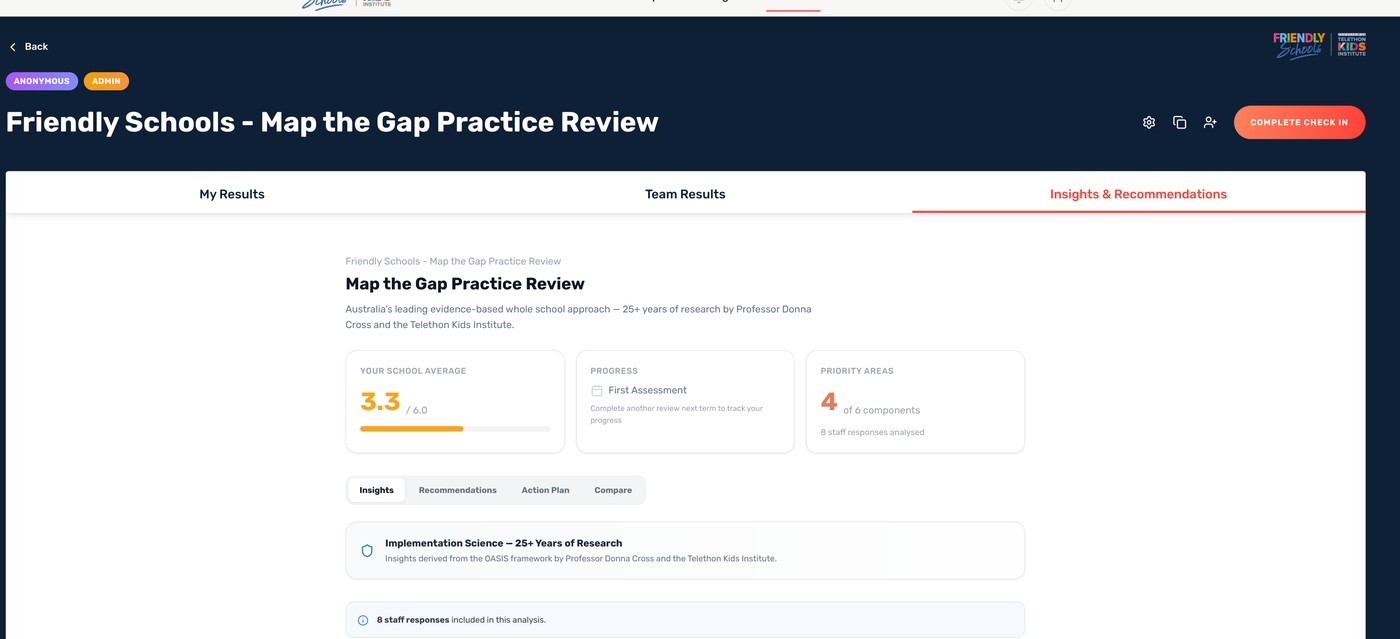
Map the Gap is how you move from talking about wellbeing to seeing where your school stands. Your whole staff answer a short review across the eight components, grouped into six areas, and your leadership team gets back a ranked priority list.
Start your $20 review →Whole staff, no accounts
Eight components, six areas
Leadership Report
What starting looks like in real schools
Friendly Schools gave us a shared language across staff. Instead of running seven different programmes, we had one framework that everyone could see themselves in.Primary school, Western AustraliaSSSK pilot case study (2022)
The Map the Gap session was the first time our wellbeing team had an honest conversation about where we actually were. It stopped us over-promising.Secondary college, VictoriaSSSK pilot case study (2023)
Questions schools ask us first
How does Map the Gap work?
Your wellbeing leader sets it up and sends your staff a link. Each staff member answers on their own, with no account. The review covers the eight components, grouped into six areas.
What if my school isn’t ready for whole-school change?
That’s exactly what the 11-question Readiness Check is for. Low scores don’t disqualify you — they flag where to build capacity first. Schools often spend a term on foundation-building before Stage 2, and that’s the right call.
Is there a minimum commitment?
Map the Gap is a one-off $20 review, including GST, with no ongoing commitment. The full program is invoiced to the school each year.
Who on our staff should drive this?
Usually one coordinator with explicit backing from the principal. Schools that succeed have a named lead, protected time (typically 0.1–0.2 FTE), and a leadership sponsor who shows up at milestones. Schools that stall have “everyone owns it” without anyone owning it.
How does this fit with what we already run (Respectful Relationships, PBS, Be You)?
Friendly Schools maps to the same general capability (ACARA Personal & Social), works alongside Be You (Emeritus Professor Donna Cross OAM is an architect of both), and complements behaviour frameworks like PBS. Most schools layer it on rather than replace anything.
What does it cost, end-to-end?
$20, including GST, for Map the Gap. Books and packs from $29.95 to $475, with unlimited printing inside your school. The full program is $3,000 a year for schools up to 200 students, $5,000 up to 600 and $7,000 above that, all plus GST, invoiced to the school. Additional support is quoted separately. See the full comparison →
We’re in NSW. Does this help us meet the 2027 Anti-Bullying Framework requirements?
Yes, directly. The NSW Anti-Bullying Framework’s four components — Responding, Preventing, Implementing, Partnering — draw on the same body of evidence that has shaped Friendly Schools since 1999. The framework follows the federal Anti-Bullying Rapid Review delivered in 2025; expect other states to follow with their own mandates. Starting now gives you a full academic year before the Term 1, 2027 mandate lands.
We're with you every step
Questions? Ready to chat? We'd love to hear from you.

Evidence-based wellbeing for Australian schools. Built on 25+ years of research at The Kids Research Institute Australia.
Friendly Schools acknowledges the Whadjuk Noongar people as the traditional custodians of the land on which our work began, and pays respect to Elders past and present.